Begin with the role of music
Music may be asked to welcome guests, carry a ceremony, shape dinner, support speeches, invite dancing or lead the transition into an after-party. These are different musical jobs. The lineup should be chosen after the programme is understood, not before.
For a complementary planning perspective, explore Designing a Custom Music Lineup for a Destination Wedding in Vietnam.
A ceremony built around violin and piano requires a different set of strengths from a reception that moves between elegant background music and high-energy dance sets. The question is therefore not “How many people should be on stage?” but “Which musical roles must be present for this experience to work?”
What each scale of lineup can do
A focused feature format—such as a solo instrumentalist or vocalist with accompaniment—can create intimacy for a ceremony, welcome dinner or one carefully chosen moment. A duo or trio works well when the goal is warmth, conversation-friendly sound and a visually restrained footprint.
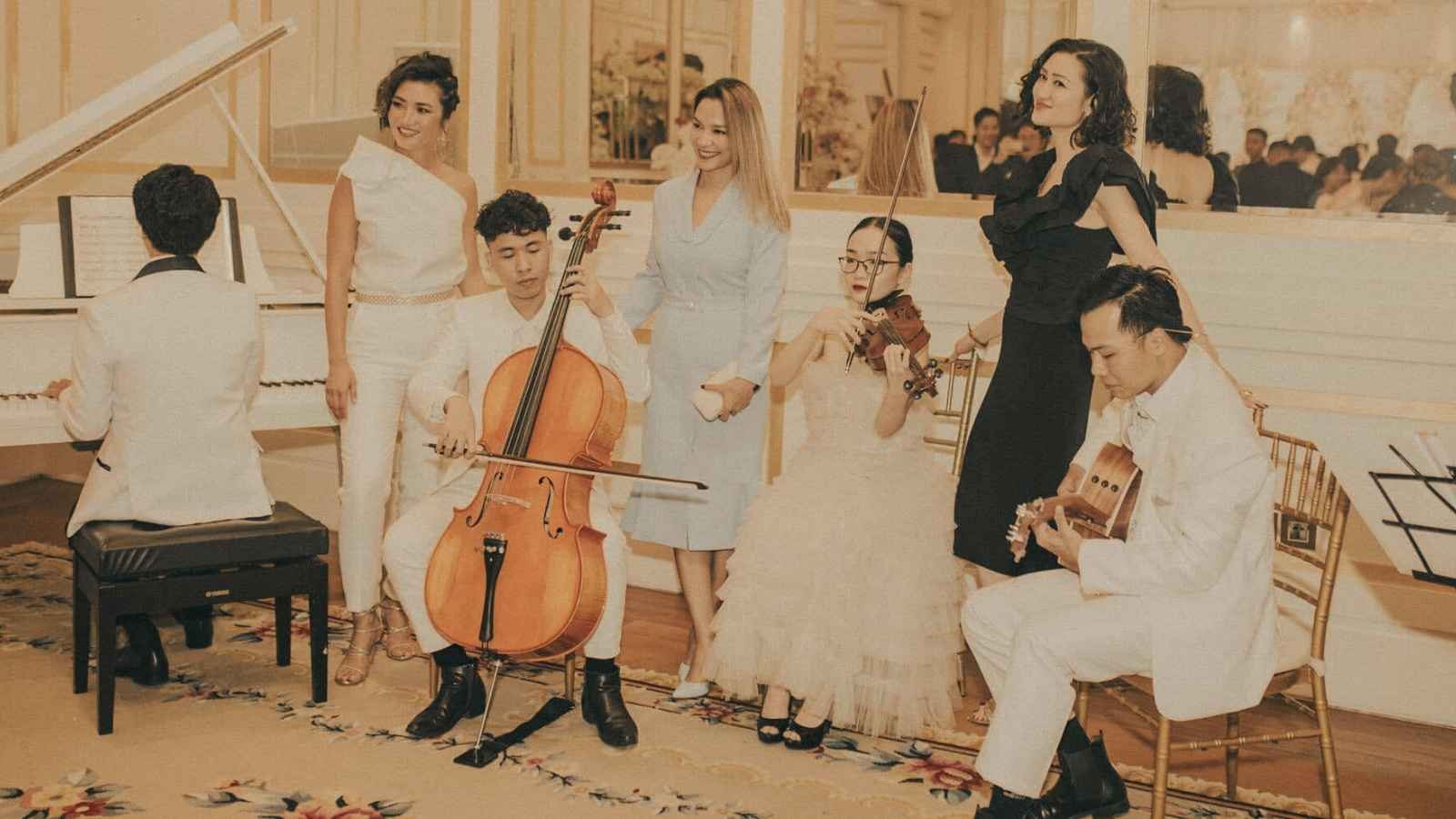
A compact ensemble adds harmonic range, rhythmic depth and more flexibility between background listening and featured performance. Lux Band’s six-performer Acoustic Elegance and Modern Live Band concepts are designed for broader programme arcs: multiple vocal colours, instrumental detail and a stronger transition into celebration.
A useful next step is understanding Acoustic Band or Modern Live Band for Your Wedding?.
A practical lineup decision matrix
| Format | Best suited to | Primary strength | Key limitation |
|---|---|---|---|
| Focused feature | Ceremony or signature moment | Clarity and intimacy | Limited programme range |
| Duo / trio | Welcome dinner, cocktail, refined reception | Warmth with a small footprint | Less rhythmic and vocal breadth |
| Compact ensemble | Multi-phase reception | Flexible dynamics | Requires more stage and sound planning |
| Six-performer concept | Full wedding programme | Vocal, rhythmic and stylistic range | Needs coordinated production |
| Custom ensemble | Signature or cinematic brief | Distinctive musical identity | More rehearsal and logistics |
Venue and guest count affect scale—but not mechanically
A large guest count can increase the need for sound coverage, but sound reinforcement and musician count are not the same decision. A small band with a suitable system can reach a large room; adding performers does not automatically solve difficult acoustics.
The venue matters through stage dimensions, ceiling height, room width, sightlines, multiple zones and sound restrictions. A six-performer concept may fit naturally in a ballroom but feel visually crowded on a narrow terrace. Conversely, a duo may look and sound too slight if it is expected to carry a large dance floor for the entire evening.
Choose luxury through intention, not excess
A larger lineup is not automatically more luxurious. Luxury is the sense that every role is necessary, the arrangement is balanced and the musicians belong in the architecture of the celebration.
The strongest recommendation often combines restraint in one phase with expansion in another: a focused ceremony format, a broader reception ensemble and a DJ or playback transition later. The lineup should follow the emotional arc rather than remain identical because it is administratively simpler.
This decision also connects closely with String Ensembles for a Semi-Classical Wedding Ceremony in Vietnam.
A decision sequence for couples and planners
First, define the programme moments that need live music. Second, identify the musical roles required in each moment. Third, review the venue footprint and sound conditions. Fourth, decide whether one lineup can serve the full arc or whether formats should change. Finally, confirm the production, rehearsal and movement implications.
This sequence avoids two common mistakes: selecting a large lineup for visual impact without a clear musical purpose, or choosing the smallest format before understanding what the evening is expected to become.
What changes the recommendation
The recommendation can change when the same wedding uses several performance zones. A trio that works beautifully for a covered cocktail terrace may not carry the same visual or rhythmic role once the ballroom opens. In that case, the solution may be a controlled change of format rather than forcing one group to serve every phase.
Vocal requirements also matter. One vocalist can create a coherent colour; two vocalists can widen language, register, duet and repertoire possibilities. Featured violin or saxophone can add a recognisable signature without changing the entire band architecture. These choices should be explained through musical function, not presented as decorative upgrades.
Budget remains a real boundary, but the decision should protect the roles that create the intended experience. Reducing personnel without redesigning arrangements can leave gaps. A stronger approach is to simplify the concept honestly: fewer musical roles, a more focused repertoire and a production plan built for that scale.
Before approving a lineup, couples should be able to answer three questions: Which moment would feel incomplete without live music? Which musical colour is personally important? Which parts of the programme need energy to grow? Those answers usually reveal whether the wedding needs intimacy, range or a deliberate combination of both.
Questions couples often ask
Is six performers always the recommended Lux Band format?
No. Six performers provide broad musical range, but a smaller or custom format may be more appropriate for the venue and programme.
Can one lineup perform ceremony, dinner and after-party?
Sometimes. The answer depends on the instrumentation, movement between zones and the desired change in energy.
Does a large guest count always require a larger band?
No. Guest count affects coverage, but acoustic design and sound reinforcement are separate from musician count.
Should the venue decide the lineup?
The venue should confirm operational constraints. The lineup decision should be shared by the couple, planner and music director.
Can a custom ensemble be smaller than a standard concept?
Yes. Custom refers to purpose and instrumentation, not automatically to size.
Written and reviewed by Lux Band Editorial Team
·
“The right lineup is not the largest one. It is the one in which every musician has a reason to be there.”
Choose a lineup for the programme—not a number on a package
Share your venue, programme and desired atmosphere. Lux Band will recommend the musical roles and scale that best support the celebration.
Request a lineup recommendation →